If you've spent any time reading about SEO for WordPress, you've probably come across the term "structured data" without getting a clear explanation of what it actually means or why it should matter to you. Most guides jump straight to implementation (plugins to install, code to paste) without first explaining the concept in plain English.
This article fills that gap. By the end, you'll understand what structured data is, why Google built it, and which types are most useful for WordPress bloggers specifically.
What Structured Data Actually Is
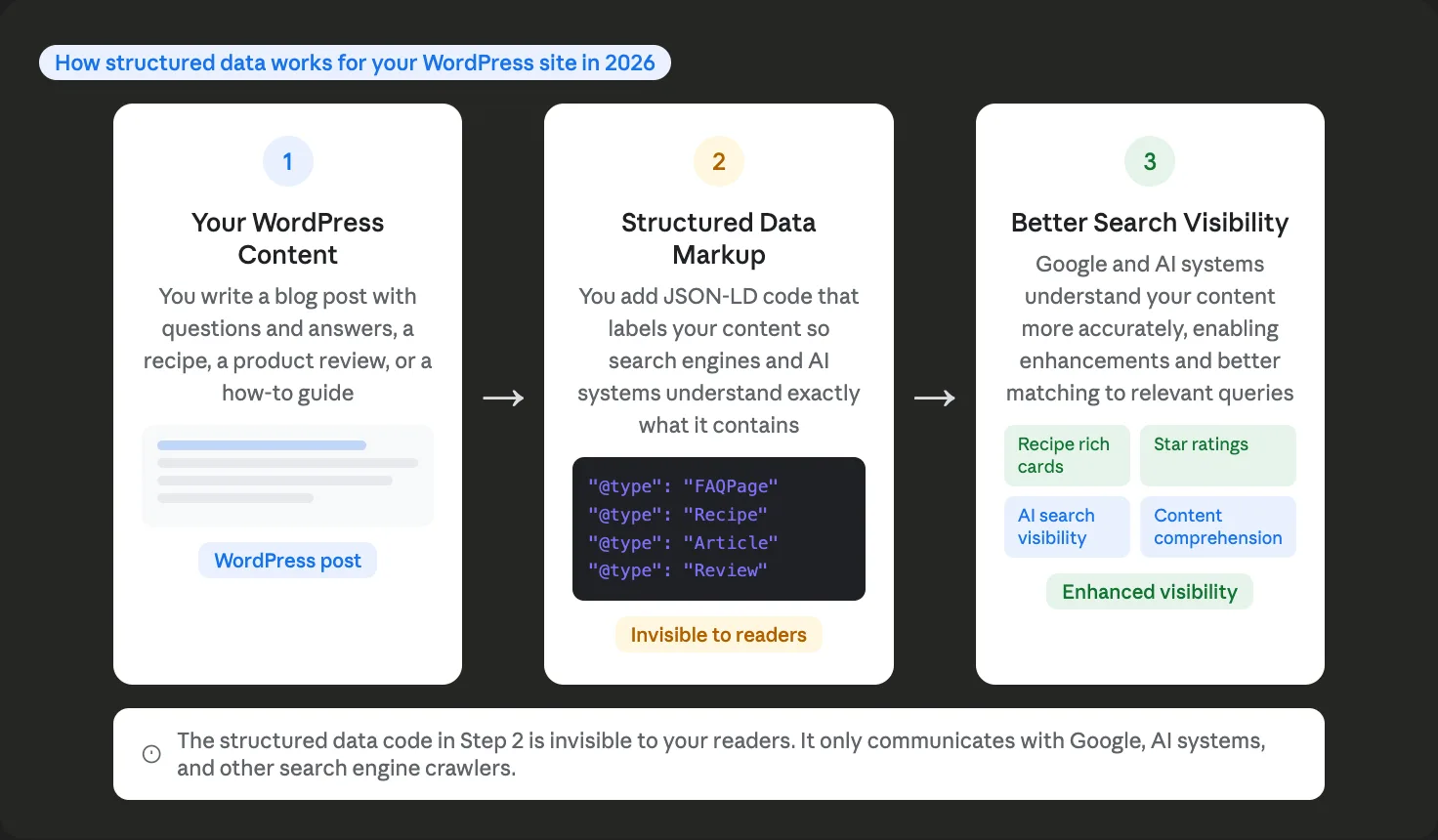
When Google crawls your WordPress post, it reads your content the way a very fast but literal-minded reader would. It can identify words, sentences, and HTML tags, but it has to infer meaning from context. Is this page a recipe? An event listing? A product for sale? A blog post with questions and answers? Google makes educated guesses based on your content, and guesses aren't always right.
Structured data is a way to remove the guesswork. It's a block of code you add to your page that explicitly labels your content in a format Google is designed to read. Instead of Google inferring that your post contains a list of questions and answers, structured data tells it directly: "This is an FAQPage, and here are the specific questions and answers it contains."
The code itself is invisible to your readers. It lives in the background of your page's HTML and communicates only with search engine crawlers. Your post looks identical to visitors. To Google, it carries a precise description of what your content is and how it should be understood.
Where Structured Data Comes From
The vocabulary used for structured data is defined by Schema.org, a collaborative project created by Google, Microsoft, Yahoo, and Yandex in 2011. Schema.org defines hundreds of content types and their properties, ranging from basic articles and blog posts to highly specific types such as medical conditions, legislation, and chemical substances.
The terms "structured data," "schema markup," and "schema" are often used interchangeably, though they're technically distinct: Schema.org defines the vocabulary; structured data is the broader concept of marking up content in a machine-readable format; and schema markup is the code that implements it. For practical purposes, as a WordPress blogger, you can treat them as the same thing.
Why Google Built This System
Google's core challenge is that the web is enormous and unstructured. Billions of pages contain useful information, but that information is formatted in countless different ways: different layouts, different writing styles, different conventions for organizing content.
Structured data solves this problem by giving publishers a standardized way to communicate with search engines. When you add structured data to your pages, you're essentially giving Google a labeled summary of your content rather than having it figure everything out on its own.
The benefit for Google is more accurate search results. The benefit for you is that correctly labeled content may become eligible for enhanced search features, which Google calls rich results.
What Rich Results Are and Why They Matter
Rich results are the enhanced search listings you've seen in Google: recipe cards with star ratings and cooking times, event listings with dates and ticket links, and product listings with prices and availability. Many of these enhancements rely on valid structured data on your page.
A standard search result shows your title, URL, and meta description. A rich result can show significantly more and take up substantially more space on the results page, pushing competing results further down.
For WordPress bloggers, rich results translate directly to higher visibility and better click-through rates at whatever position you already rank. You don't need to climb from position six to position two. In some cases, a rich result lower on the page can attract more attention than a standard result ranking above it because it appears more prominent and informative.
The Types of Structured Data Most Useful for WordPress Bloggers
Not all structured data types are equally relevant to blogging. It is also worth knowing that Google has retired several structured data types between 2023 and 2026 as part of an ongoing effort to focus on features that deliver genuine user value. The types listed here are among the well-supported core types that continue to produce enhancements.
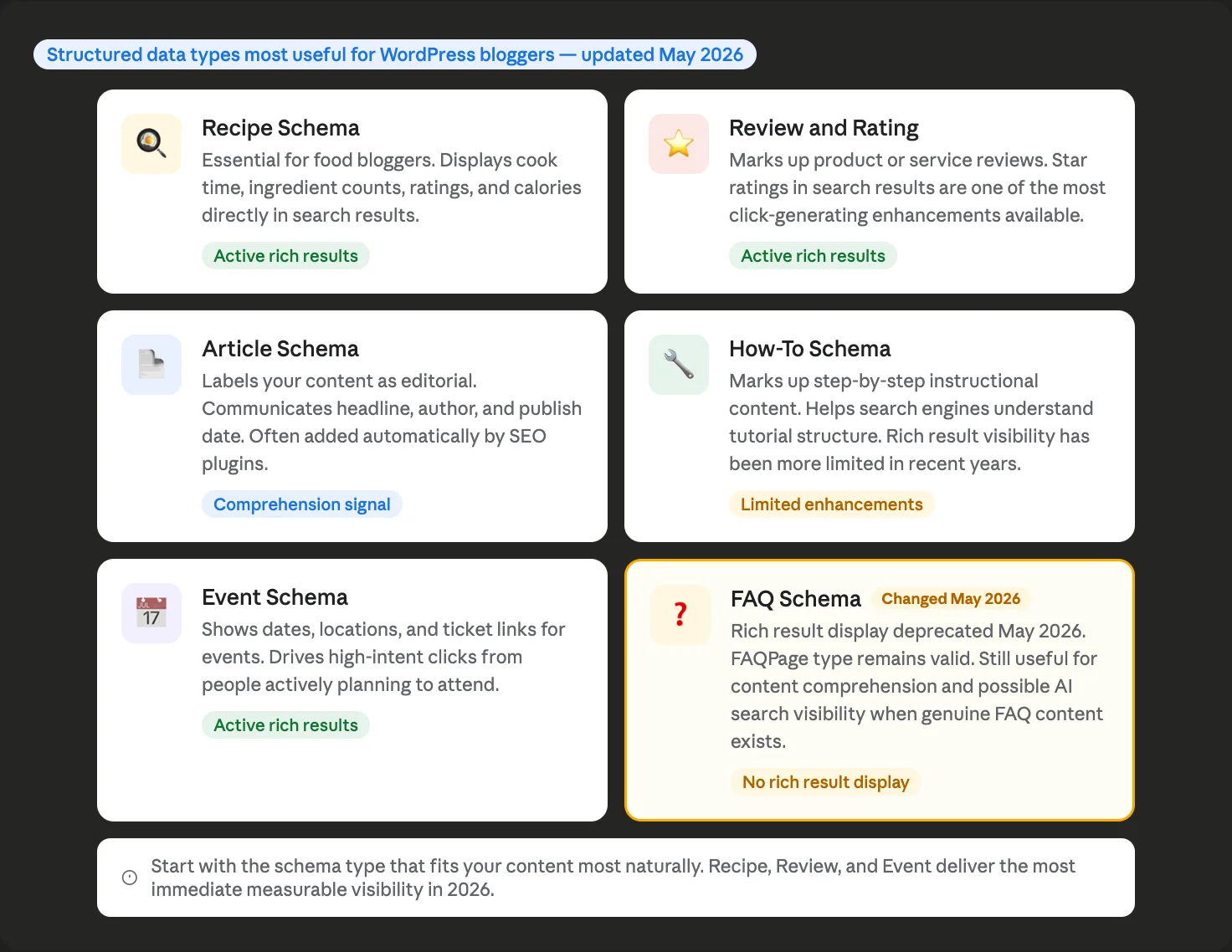
FAQ schema is a practical option for bloggers who publish content with genuine question-and-answer sections. If your posts include how-to guides, topic explainers, or informational articles with real FAQs, FAQ schema tells Google and AI systems exactly what those questions and answers are. Worth noting: Google deprecated FAQ rich results in May 2026, meaning the expandable dropdown display in search listings is no longer available. The FAQPage structured data type itself remains valid and continues to be crawled by search engines and AI systems.
Article schema helps Google understand that your content is editorial: a blog post, news article, or opinion piece rather than a product listing or recipe. It communicates the headline, author, publication date, and featured image in a format search engines read reliably. Many WordPress themes and SEO plugins automatically add basic article schema.
How-To schema applies to content that walks readers through a process step by step. If you regularly publish tutorial or instructional content, the How-To schema helps search engines understand your content structure and still supports various Google search enhancements, though its rich result visibility has been more limited in recent years.
Recipe schema is essential for food bloggers. It enables rich recipe cards that display cooking time, ingredient counts, star ratings, and calorie information directly in search results. This is a significant visibility advantage in a category where search results are extremely competitive.
Review and Rating schema applies to posts where you evaluate a product, service, or experience. Star ratings displayed in search results are one of the most click-generating rich result types available. Google applies stricter guidelines to review markup than it did in the past, particularly for self-authored or self-serving reviews, so stars do not appear automatically, and eligibility depends on how the markup is implemented.
Structured Data and AI Search
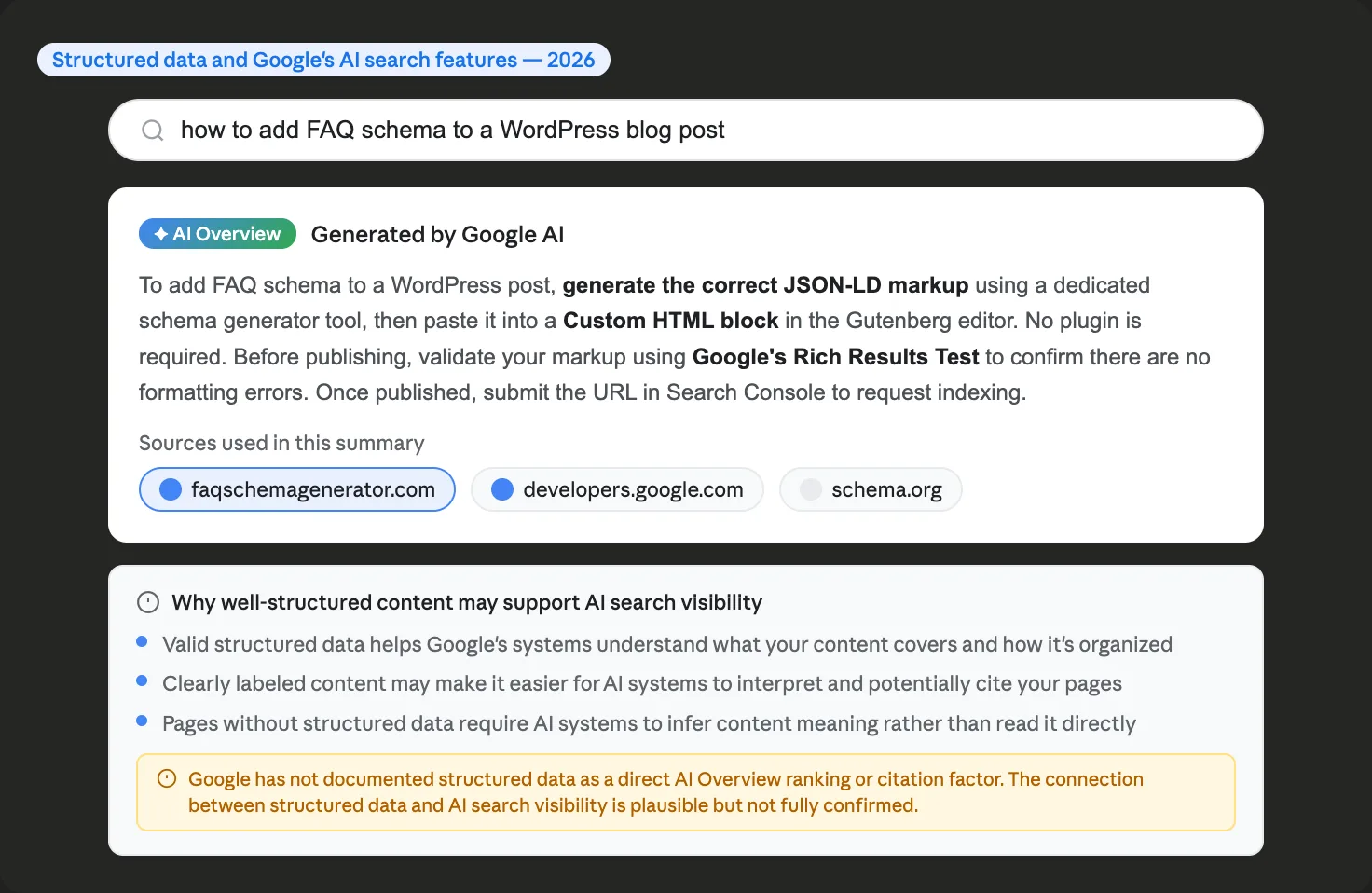
In 2026, structured data has taken on additional importance beyond traditional rich results. As AI-generated search features expand, many SEO professionals believe well-structured pages give AI systems clearer signals about content organization and topic relevance. Pages with valid structured data may make it easier for AI systems to interpret what your content covers and how it's organized.
While this connection is not fully documented by Google, many SEO professionals believe structured data improves your chances of being selected as a source in AI-generated answers. That is an increasingly valuable placement as AI search features continue to expand.
Where to Start as a WordPress Blogger
If you've never added structured data to your WordPress site, the best starting point is whichever type most naturally fits your content. For food bloggers, Recipe schema delivers immediate, measurable visibility. For product or service pages, the Review and Rating schema is one of the highest click-through enhancers available. For informational and how-to content, the Article schema helps establish your content as editorial in Google's eyes.
FAQ schema remains a reasonable option for posts with genuine question-and-answer sections, though with a realistic understanding of what it delivers in 2026. Google deprecated FAQ rich results in May 2026, so the SERP display benefit is no longer available. The content comprehension benefit and possible AI search visibility remain. If your post has a genuine FAQ section that serves readers, adding the markup takes five minutes and carries no downside.
You don't need to implement every schema type at once. Start with your highest-traffic posts and the schema type that fits them most naturally. Validate the markup with Google's Rich Results Test and monitor the results in Search Console. From there, expand to other schema types as they become relevant to your content.
Structured data remains one of the more durable technical SEO practices available to WordPress bloggers. Rich result features come and go, but accurately labeling your content for machine reading is as relevant in the AI search era as it has ever been. The opportunity is still there for bloggers willing to do the work.