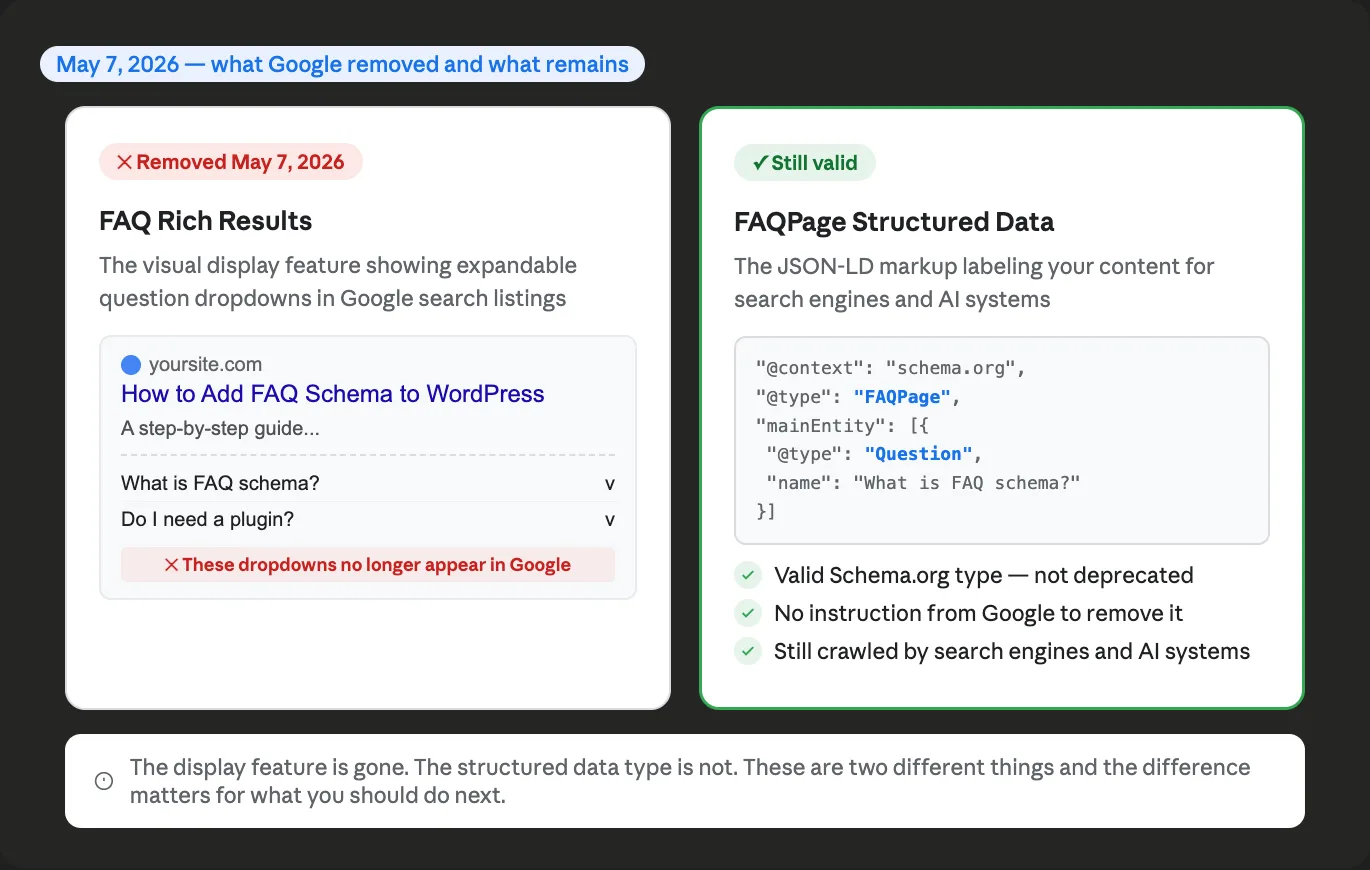
Google deprecated FAQ rich results on May 7, 2026. If you've been using FAQ schema on your WordPress posts, you may be wondering whether to remove it, keep it, or stop adding it to new posts entirely.
The answer depends on being clear about what "still works" means now that the rich result display is gone. There are two separate questions worth distinguishing: does FAQ schema still do anything useful, and is it worth adding to new posts? The answers are yes and probably, in that order.
Here's an honest assessment of where things stand.
What the Deprecation Actually Means
When Google deprecated FAQ rich results, it removed the display feature that showed expandable question-and-answer dropdowns beneath individual search listings. That visual enhancement is gone, and it will not come back.
What Google did not do is deprecate the FAQPage structured data type itself. Google stated that FAQ structured data may still be used to help understand page content, even though the FAQ rich result display has been removed.
This distinction matters practically. The markup you've added to your pages is still valid Schema.org markup. FAQPage schema is not deprecated. You can keep it, remove it, or refactor it without affecting Google rankings.
The SEO industry has produced two overcorrected reactions to this news. Some declared FAQ schema entirely dead and advised removing it everywhere. Others claimed it now matters more than ever for AI search. Neither reaction is fully accurate. The rich result is gone. The schema type is not. Those two things are different, and the difference decides what you should actually do.
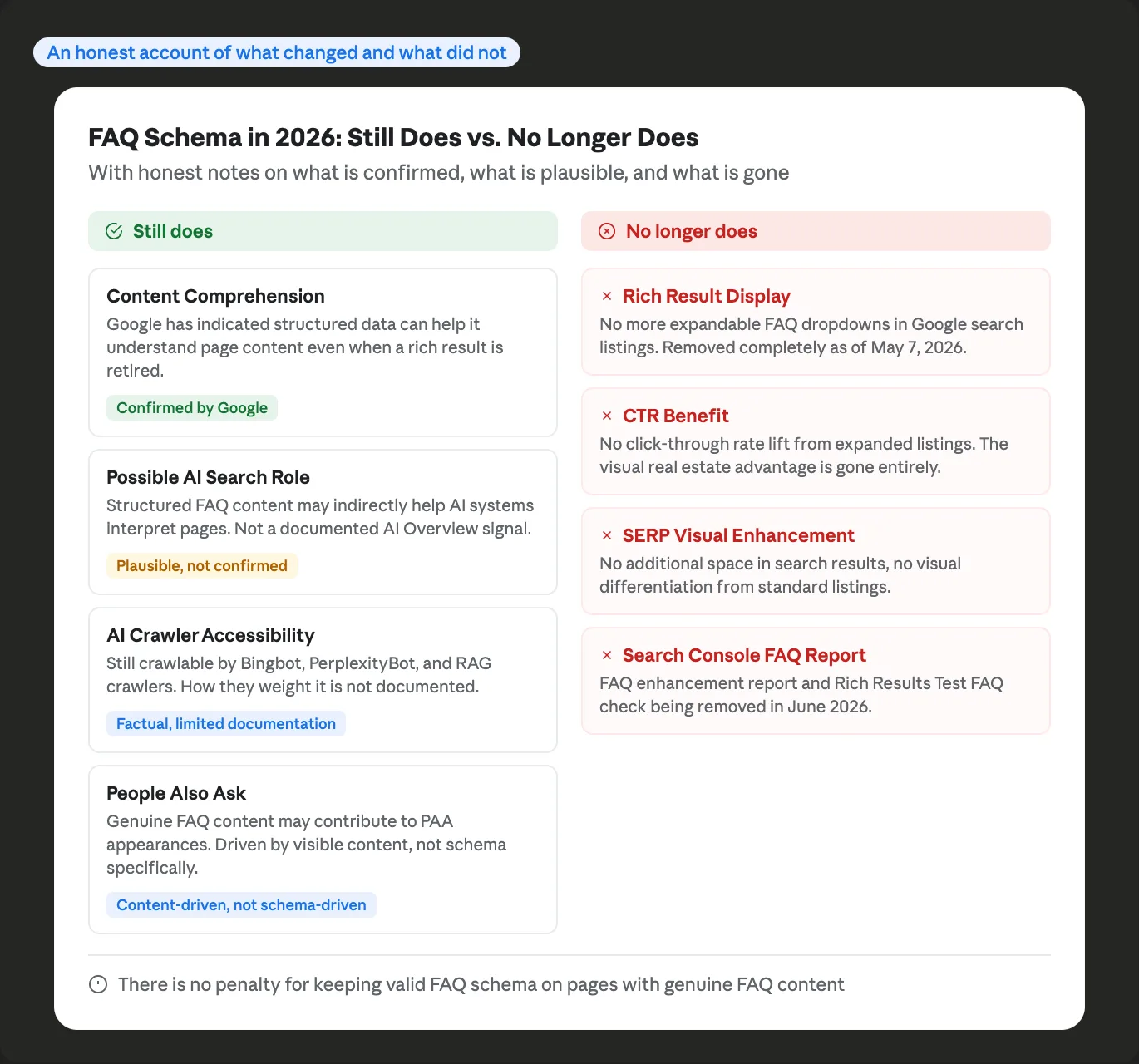
What FAQ Schema Still Does
With the rich result display gone, the remaining value of FAQ schema has narrowed and shifted. Here is an honest account of what it continues to do.
Content Comprehension
Google has indicated that structured data can still help it understand page content, even when a specific rich result feature is retired. The markup may contribute to how accurately Google interprets what your content covers, which affects how well your pages match question-based search queries even without any visible enhancement in the results.
A Possible Role in AI Search
This is where reasonable uncertainty exists and honesty matters. Because AI Overviews and Gemini-powered search features rely on Google's broader understanding of web content, some SEO practitioners believe structured FAQ content may indirectly help AI systems interpret pages more clearly. However, Google has not documented FAQPage schema as a direct AI Overview ranking or citation factor.
The argument for FAQ schema as an AI visibility signal only holds if the underlying content actually works as Q&A. Google's content guidelines for FAQ markup, which remain in place even after the rich result deprecation, require that the questions and answers appear as visible content on the page, that the questions are written by the site rather than user-submitted, and that the answers are not promotional or repetitive.
Crawlability by Other Systems
FAQPage structured data remains a valid Schema.org type. The markup continues to be crawlable by Bingbot, PerplexityBot, and the various retrieval-augmented generation crawlers indexing the open web. Whether and how those systems weight FAQPage markup specifically in source selection is not publicly documented, but the markup does not prevent crawling and may make structured Q&A content easier to parse.
People Also Ask
Visible FAQ sections on your page may still contribute to appearing in Google's People Also Ask boxes. People Also Ask is driven primarily by Google's understanding of visible page content rather than FAQPage schema itself, but writing genuine FAQ content continues to serve this purpose.
What FAQ Schema No Longer Does
Being equally clear about this matters.
FAQ schema no longer affects how your listing looks in Google search results. There are no expandable dropdowns, no additional visual real estate, and no click-through rate benefit from the schema itself. For the vast majority of sites, the SERP rich snippet value of FAQ schema is zero. Continuing to write content explicitly to chase FAQ rich snippets is wasted effort. The playbook does not work anymore.
This is a complete break from the value proposition that made FAQ schema popular between 2019 and 2023. If your reason for adding FAQ schema was primarily to earn rich results, that reason no longer applies.
Should You Keep Existing FAQ Schema?
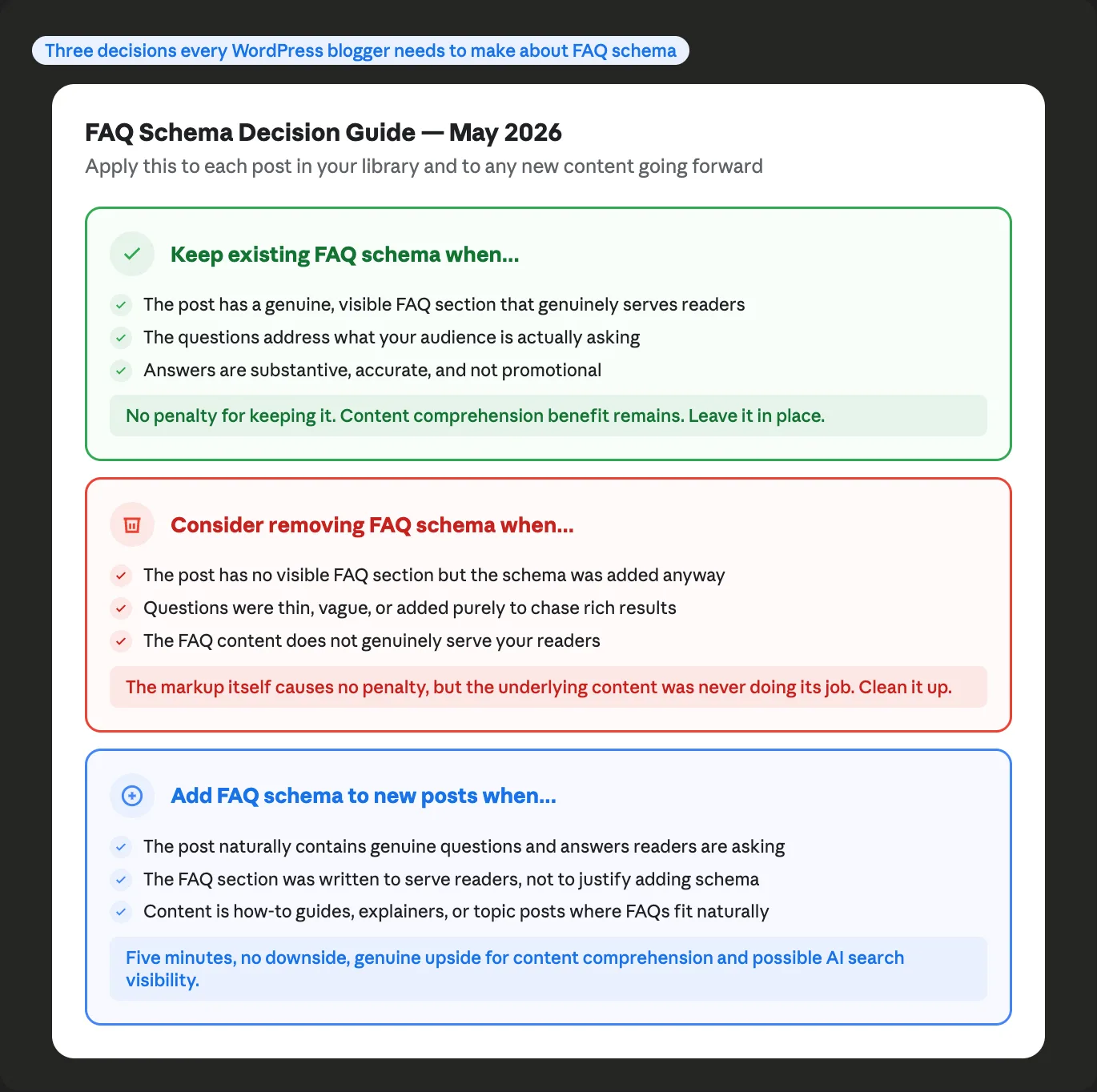
Yes, with one qualification. If the content is valuable, leave it. If the schema was purely for rich results that no longer exist, new implementations should be carefully considered.
More specifically, the right approach is selective rather than wholesale. Remove FAQ schema from posts where you added it without a genuine FAQ section, where the questions were thin or loosely related to the content, or where the markup was created purely to chase rich results rather than serve readers. Keep FAQ schema on posts where the FAQ content is substantive, genuinely useful to readers, and naturally structured as questions and answers.
Google has stated that unused structured data does not cause problems for Search, so there is no penalty for leaving valid markup in place. But cleaning up decorative or low-quality FAQ schema is still worthwhile because the underlying FAQ content was never genuinely serving readers.
Should You Add FAQ Schema to New Posts?
This is the more nuanced question, and the honest answer is: only when the content warrants it.
If you are writing a post that naturally contains genuine questions and answers that readers are actually asking, adding FAQ schema takes five minutes and carries no downside. The content comprehension benefit is real, the AI search connection is plausible if uncertain, and the markup does not hurt anything.
If you are adding a FAQ section to a post primarily to justify adding schema, that is the behavior Google's deprecation was responding to. The standard for adding FAQ schema in 2026 is simpler than it was before: if your post has a genuine FAQ section that serves your readers, add the schema. If it doesn't, don't create one just for the markup.
The Broader Context: Structured Data Is Still Worth Doing
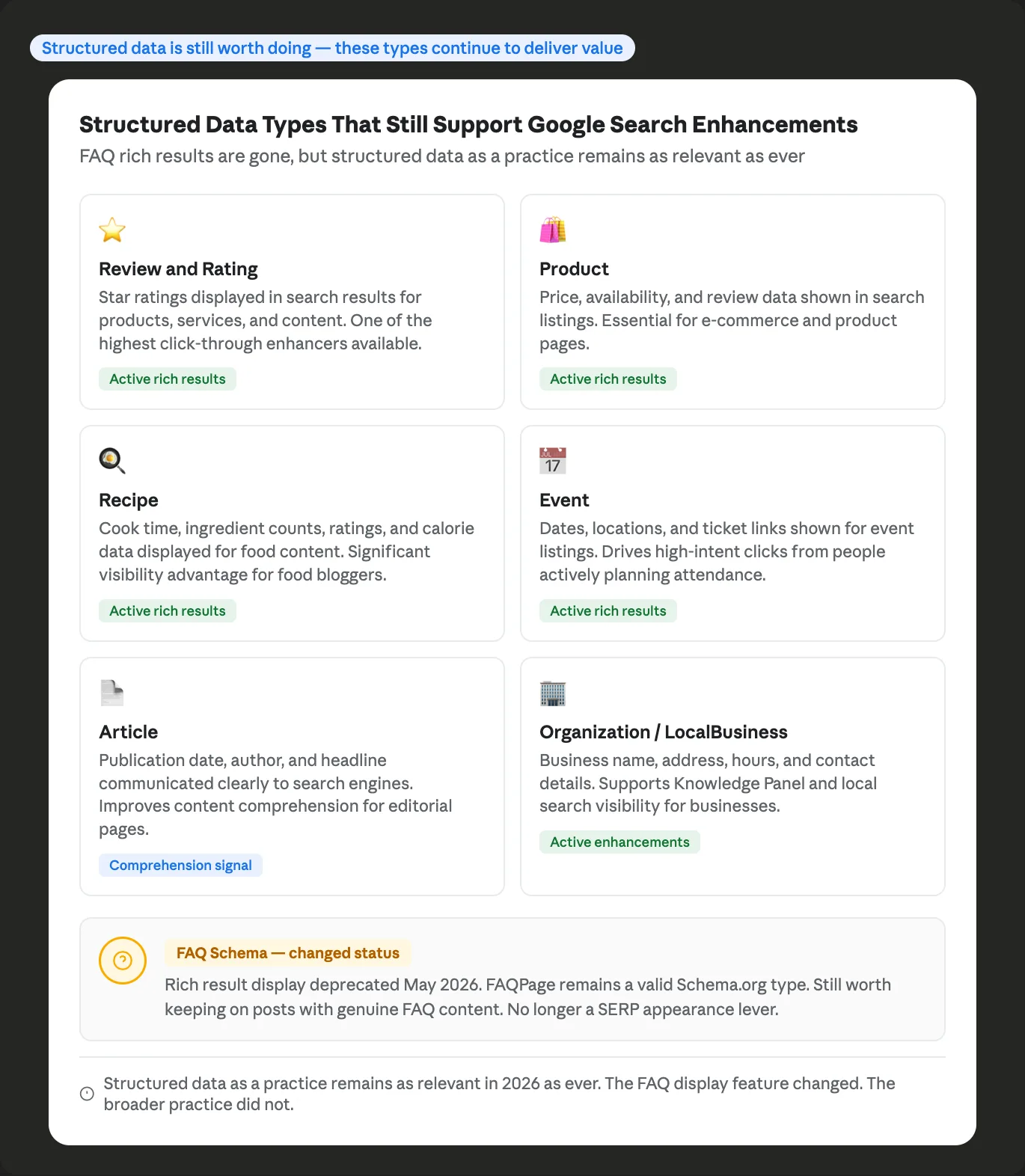
Google representatives, including John Mueller, have repeatedly noted that rich result features evolve over time. Some structured data types retain long-term value, while others lose their associated visual enhancements. FAQ schema fits that pattern. The rich result is gone. The FAQPage type remains valid.
The practical implication is not to abandon structured data as a practice, but to evaluate each type based on what it currently delivers rather than what it delivered at its peak.
Product, Article, Review, Recipe, and Event structured data still support various Google search enhancements and deliver measurable value. Structured data as a practice — labeling your content accurately for machine reading — remains as relevant in 2026 as it has ever been. For WordPress bloggers, the question is not whether to use structured data but which types are worth implementing given what they currently do.
For FAQ schema specifically, the answer in 2026 is: keep what's working, add it when content genuinely warrants it, and stop treating it as a SERP appearance lever, because that lever no longer exists.